
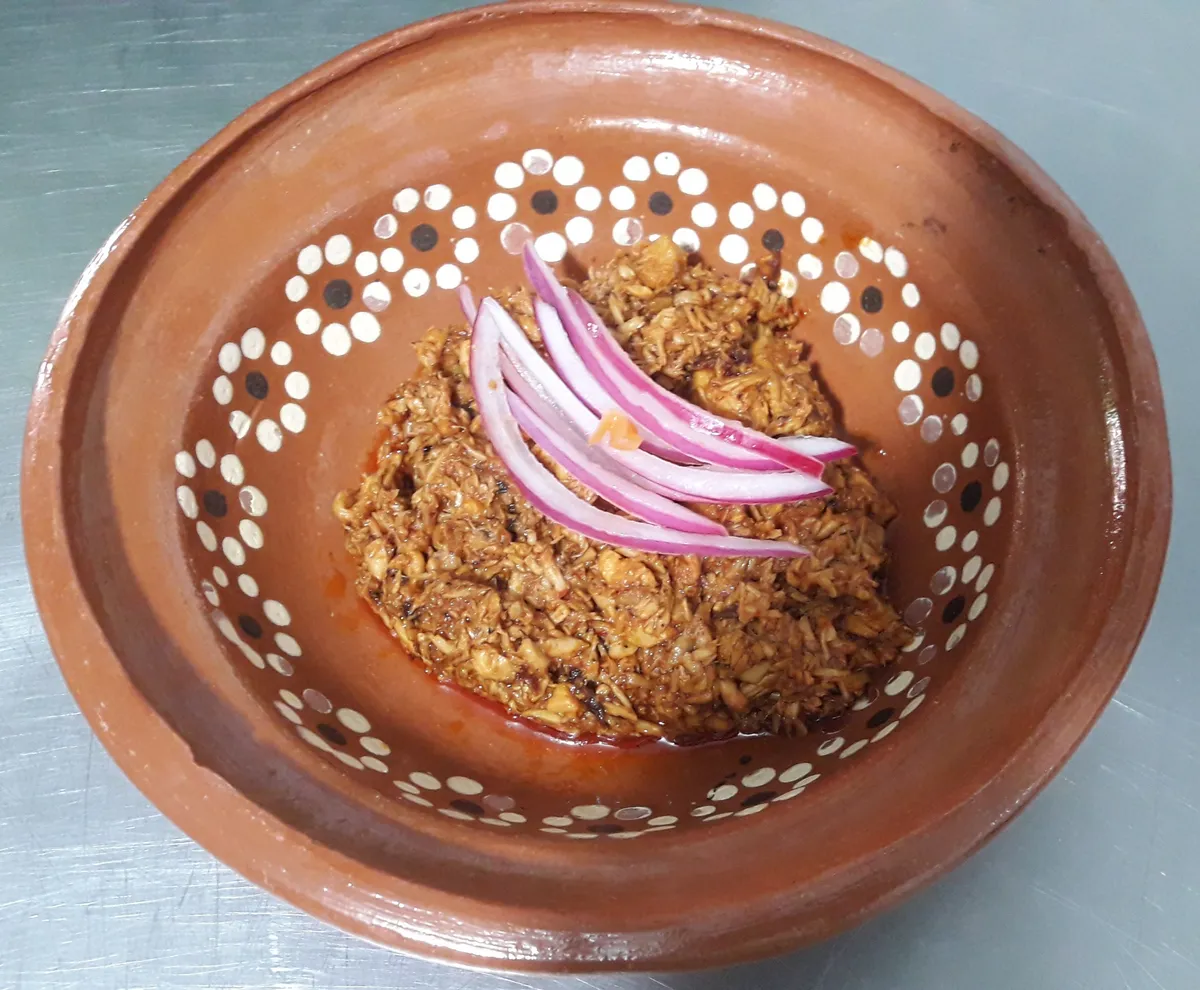
Chilorio
A dish of shredded pork, slow-cooked in lard and seasoned with a sauce of dried chiles, vinegar and spices. It is one of Sinaloa's most representative dishes; the version made in Mocorito became, in 2026, the state's first Protected Geographical Indication.
Overview
Chilorio is made by simmering pork until it falls apart easily, frying it in its own lard, and finishing it in a sauce of rehydrated dried chiles — commonly pasilla, ancho or the reddish colorado type — with garlic, oregano, cumin, black pepper and vinegar. The result is a deep reddish, smoky-tasting meat with moderate heat, usually served in tacos, burritos, or alongside refried beans.
It is one of the dishes most closely identified with Sinaloan cooking as a whole, found on tables across the state — from Culiacán to the towns of the north — and is also one of the best-known packaged products Sinaloa ships to the rest of Mexico.
History
Various accounts place chilorio's origin more than 300 years ago, tied to techniques for preserving pork in lard; there is, however, no single documentary record fixing an exact date or place of origin, so that age should be read as a widely repeated tradition rather than a precisely verified fact.
On 6 May 2026 Mexico's Institute of Industrial Property (IMPI) published the declaration of protection for the Geographical Indication "Chilorio de Mocorito," the first of its kind granted to a Sinaloan product. The protection specifically covers chilorio made in the municipality of Mocorito, recognizing a preparation tradition of more than three centuries in the area.
Traditional preparation
The traditional method starts from cuts of pork — often leg or loin — simmered in water or in their own fat until very tender, then shredded by hand or with two forks. The shredded meat is fried in lard and finished in an adobo made from soaked, ground dried chiles together with garlic, oregano, cumin and vinegar, cooking until the meat takes on the sauce's color and flavor. There are no vegetables or filling involved: it is the meat itself, transformed by slow cooking and the chile adobo, that defines the dish.
Regional association
Municipality
Related topics
- History
Sources and data
The information on this page comes from public sources.
- Publicación de nuevas declaraciones de protección de indicaciones geográficas — Chilorio de Mocorito — Arochi & Lindner (boletín de propiedad intelectual)
- Chilorio — Diccionario enciclopédico de la Gastronomía Mexicana — Ediciones Larousse