
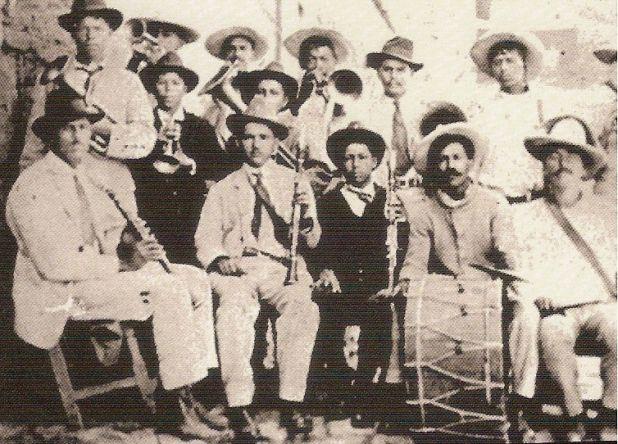
Banda sinaloense: a wind-band musical tradition
Wind-band music with documented roots in rural nineteenth-century Sinaloa, which a century later became, in the United States, an unprecedented commercial phenomenon.
Published: September 11, 2026
Image: Autor desconocido · Wikimedia Commons · Dominio público (publicado antes de 1931)
A music of humble origins
Banda is a wind-band musical genre — trumpets, clarinets, trombones and the tambora drum — that, according to ethnomusicologist Helena Simonett's academic research, originated in northwestern Mexico, mainly the state of Sinaloa. Its origins trace back to the nineteenth century, as street music played at cattle fairs, carnival processions and popular fiestas; the piercing brass and the tambora were a practical necessity so the music would not be lost in the noise of trade and festivity. The original repertoire combined waltzes, corridos and sones sinaloenses.
El Recodo and one of its most influential bands
One of the best-documented cases in the tradition's development is that of Banda El Recodo, founded in 1938 by Cruz Lizárraga in the locality of El Recodo, in the municipality of Mazatlán. The group recorded for the first time in 1954 and, over more than eight decades, became one of the most nationally and internationally prominent Sinaloan bandas. Its 1938 founding, however, does not mark the genre's origin: Sinaloa's banda tradition is, per Simonett's own research, several decades older, with documented roots reaching back to the nineteenth century.
From Sinaloa to a cross-border phenomenon
As waves of Mexican migrants moved to the United States, banda traveled north with them. In California, for much of the twentieth century, the music enjoyed no more acceptance than the migrants themselves. That changed in the early 1990s: as Simonett documents, banda became a symbol of ethnic pride within the Mexican-American community, the Los Angeles Spanish-language radio station KLAX became, in 1992, the highest-rated station in all of California, and Billboard magazine declared 1993 "the banda year." The genre's later shift toward "technobanda" — which replaces much of the wind instrumentation with synthesizers and electronic arrangements — is another chapter of the same tradition, not a break from it.
Related topics
- History
- Music
Related to this story
Sources and data
The information in this story comes from public sources.
- Banda: Mexican Musical Life Across Borders — Wesleyan University Press (2001)
- Review: Banda – Mexican Musical Life Across Borders — Cambridge University Press