
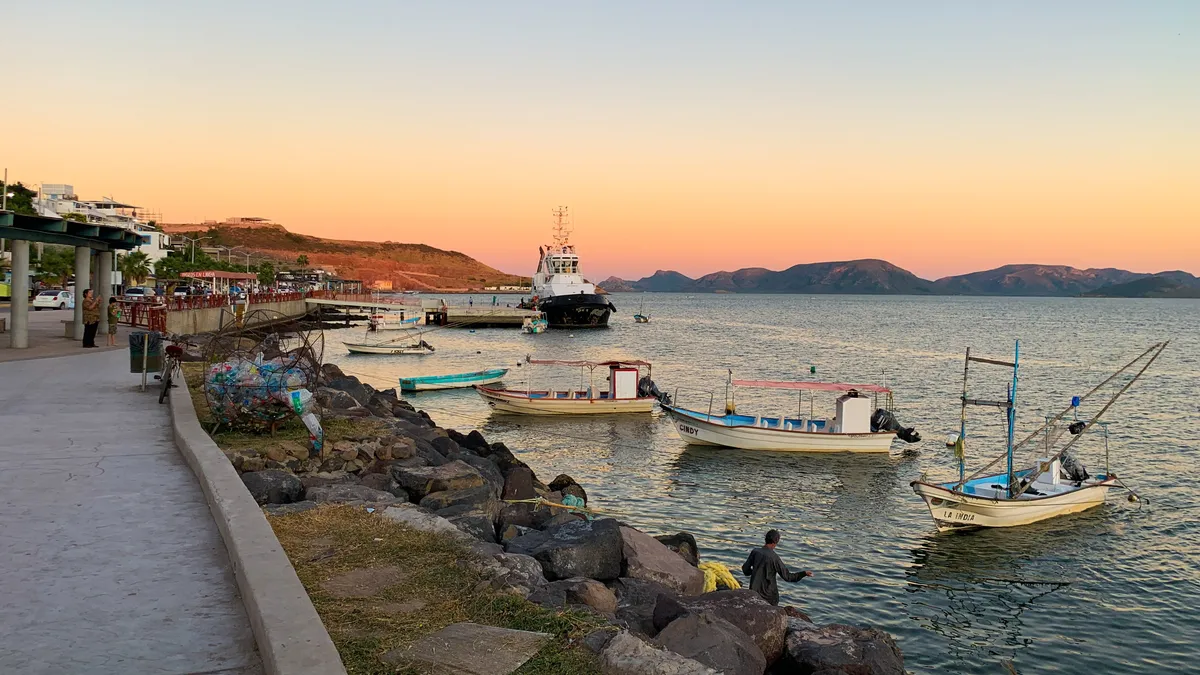
The port of Topolobampo and the development of northern Sinaloa
A sheltered bay on the coast of Ahome was first the site of a utopian socialist colony, and later the destination of a railway that took eight decades to complete. Together, they shaped the port — and the network of communities now known as northern Sinaloa.
Published: September 11, 2026
A bay on the Ahome coast
The bay of Topolobampo, in the municipality of Ahome, forms a roughly 225-square-kilometer system of sheltered estuaries together with the bays of Ohuira and Santa María, on the Gulf of California. Its natural depth made it, from the nineteenth century onward, one of the few points on the Sinaloan coast able to receive deep-draft vessels, and it holds today, alongside the port locality of Topolobampo, one of the state's deep-water ports.
A colony and a concession, 1881-1896
In 1881, the American engineer Albert K. Owen obtained a concession from the Mexican government to build a railway linking the interior of the country with a port of its own on the bay of Topolobampo. Owen used the concession to also promote a socialist-inspired cooperative colony on the site: starting from a recruitment campaign launched in 1884, the first colonists — from the United States and elsewhere — began arriving in 1886, and the settlement grew to more than a thousand people by the mid-1890s. Neither Owen's original railway project nor the colony, however, prospered: by the mid-1890s most of the colonists had left the site. The historian Sergio Ortega Noriega documented this episode — little known outside Sinaloa — in his book El edén subvertido, published by Mexico's National Institute of Anthropology and History (INAH).
A railway to the Pacific, at last
The railway Owen had envisioned would take eight more decades to complete, under different hands than his own. Starting in 1900, the American businessman Arthur E. Stilwell took up the idea of linking the central United States with Topolobampo through the Kansas City, Mexico and Orient Railway. Construction proceeded in stages between 1902 and 1914, interrupted by financial troubles and by the Mexican Revolution. Mexico's government acquired the company's rights in 1940 and, in 1955, merged the existing sections under the name Ferrocarril Chihuahua al Pacífico. The full line, from Chihuahua to Los Mochis, was not finished until 1961 — eighty years after Owen's original concession.
A port and a network of communities
The railway also brought the growth of Los Mochis, the planned city that became the seat of the municipality of Ahome and the main urban center of the Valle del Fuerte, a few kilometers from the port. Over the course of the twentieth century, a network of transport and economic activity — agricultural, fishing and port-related — grew up between the bay, the port locality of Topolobampo and the city of Los Mochis, linking northern Sinaloa with the rest of the country and, across the Pacific, with the wider world. The port did not emerge in isolation: it sits alongside the irrigated farmland of the Valle del Fuerte, one of the most productive agricultural zones in northern Mexico, and a good share of that production has gone out through Topolobampo over the decades, alongside industrial and coastal shipping functions. The port continues to operate today as one of the Gulf of California's outlets to the open sea — heir to a history that began with a failed venture and took firmer shape, nearly a century later, with the arrival of the railroad.
Related topics
- History
- Ports
- Railways
Related to this story
Sources and data
The information in this story comes from public sources.
- Ferrocarril Chihuahua al Pacífico (El Chepe) — El Mirador — Gobierno de México (SICT)
- Puerto de Topolobampo — Acerca del puerto — Administración del Sistema Portuario Nacional Topolobampo, S.A. de C.V.
- El edén subvertido: la colonización de Topolobampo, 1886-1896 — Instituto Nacional de Antropología e Historia / Secretaría de Educación Pública
- Dinámica sociointercultural del surgimiento del puerto de Topolobampo en México — Revista CoPaLa. Construyendo Paz Latinoamericana (Red CoPaLa)